Long-term Recordings (using LARS)
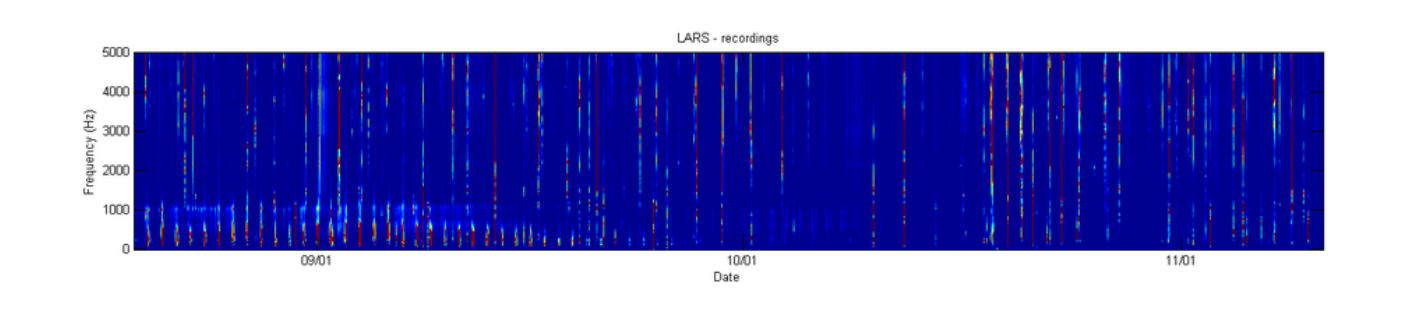
Passive acoustic recorders (LARS, Long-term Acoustic Recorder System) were placed in the estuary on tripods and long-term recordings of the soundscapes were produced. every 15 minutes, a 10-s recording was made of the ambient sound. Here we show the composite spectrogram (which is like an acoustic time-lapse recording of the soundscape, taken over several months, from mid-Aug through mid-November 2006) of the passive acoustics recorder, showing soundscape from 0-5000 Hz. Most of the fish sounds are low frequency < 1000 Hz, and in the mid-August (8/18) to mid-September (09/15). By October, the spawning sounds have greatly declined and cannot be heard. This fish have stopped their mating calls. The red areas in the spectrogram occur when red drum and Atlantic croaker are calling, mostly at night, peaking at midnight. Thus each red area represents a 24-hour period. The daytime is quiet, fishes are silent then, and these are blue areas in the spectrogram.
|
|
A typical soundscape recordingThis video is an example of 13-hour "Acoustic Time Lapse" composite spectrogram of recordings of the fishes from Pamlico Sound, NC, USA. A LARS sound recorder was placed in the estuary at 4 m depth and allowed to record 10-s recordings every 15-min for the entire summer. The 10-s recordings are placed side-by-side in this spectrogram (separated by vertical dashed lines) and and thus it compresses a 13-hour period into just 8 min of playback. These recordings are from 18 Aug 2006, part of a longer set of ambient sound recordings that were recorded from April through November in 2006.. One can hear spotted seatrout, red drum, Atlantic croaker, striped cusk eels, and bottlenose dolphin in the recordings. Try using the ECU fish sound archive elsewhere on this website to identify the fish you hear.
|
Contact UsLorem ipsum dolor sit amet, consectetur adipisicing elit, sed do eiusmod tempor incididunt ut labore et dolore magna aliqua. Ut enim ad minim veniam, quis nostrud exercitation ullamco laboris nisi.
|
Subscribe |